
Executive Series
by Todd Adest
Posted on March 12, 2026
Why the contact center may be the most underleveraged intelligence engine in your organization.
Having spent much of my career in analytics, performance, and revenue strategy, I’m struck by how much operational signal lives inside the contact center, and how rarely it influences broader enterprise decisions in a meaningful way.
For years, contact center leaders have been asked to optimize efficiency:
- Reduce handle time.
- Increase CSAT.
- Manage staffing volatility.
- Contain cost.
Those mandates still matter. They’re table stakes.
But they are performance outcomes, not strategic inputs—and that distinction matters.
For contact center leaders, this is an inflection point.
If you continue reporting performance metrics alone, you remain operational.
If you quantify and institutionalize friction signals, you become strategic.
Because operational signal is no longer just a support metric.
It is an economic input.
What Is Operational Intelligence?
Operational intelligence is the disciplined process of capturing, quantifying, and distributing friction signals from customer interactions so they inform decisions across the enterprise.
It moves beyond performance reporting (what happened) and into cross-functional action (what happens next).
When operational intelligence is institutionalized, it doesn’t just improve service metrics. It shapes product design, marketing strategy, capital allocation, and execution planning.
In simple terms, operational intelligence turns customer conversations into enterprise decision inputs.
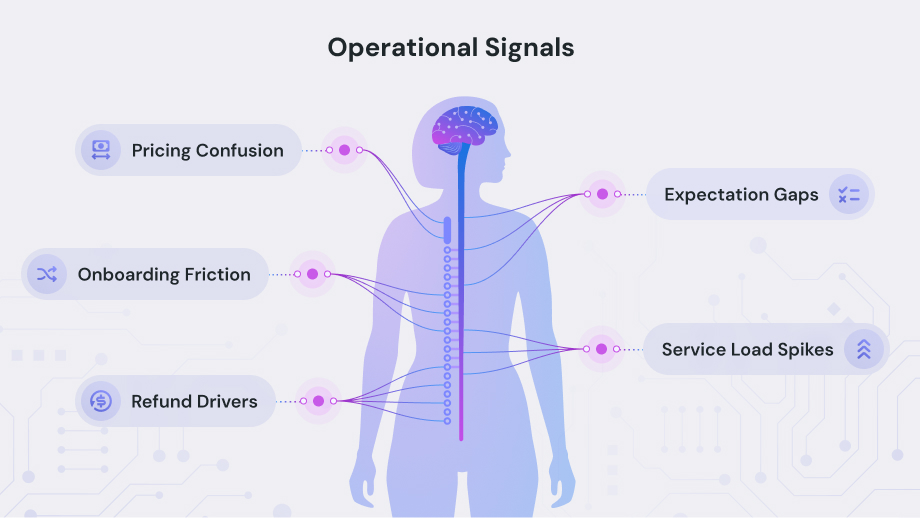
The Organization’s Nervous System
Marketing is how the organization speaks. Product is what it builds. Finance is how it allocates capital. Operations is how it executes.
The contact center is what it feels.
And nervous systems are meant to detect pain before structural damage occurs.
Every customer conversation is a signal. It reflects product clarity, pricing alignment, marketing expectations, operational execution, and customer trust.
For decades, organizations could feel this friction intuitively, but they couldn’t measure it at scale.
Now they can.
This Isn’t About Replacing AHT and CSAT
Operational metrics still matter:
- AHT
- CSAT
- FCR
- Compliance
But these measure performance. They don’t measure causality.
AHT tells you how efficiently an issue was resolved, but it doesn’t tell you why the issue existed in the first place.
CSAT tells you how the interaction felt, but it doesn’t reveal the systemic friction that created it.
When 100% of conversations become analyzable, the focus shifts:
- From resolving issues to detecting patterns
- From measuring outcomes to understanding causes
- From containment to influence
Dashboards Show Results. Conversations Reveal Risk.
Executive dashboards measure outcomes: Revenue. Churn. Margin. Cost.
Operational conversations surface precursors: Confusion. Expectation gaps. Refund drivers. Service load variance. Early dissatisfaction.
Contribution margin does not erode in spreadsheets.
It erodes in friction.
Returns. Refunds. Disproportionate support demand. Misaligned acquisition expectations. These signals surface in conversations long before they appear in financial reporting.
When friction patterns aren’t quantified and shared, capital allocation is made on partial visibility.
That’s not a people problem. It’s an infrastructure problem.
What Institutionalizing Operational Signal Looks Like
This shift doesn’t require a reorganization.
It requires three structural changes:
- Move from sample-based QA to full-spectrum conversation visibility.
- Quantify friction patterns, not just performance metrics.
- Create structured feedback loops so operational signals inform product, pricing, marketing, operations, and finance decisions.
When those structural changes happen, Product sees confusion before churn spikes. Finance sees service load variance before margin compresses. Operations sees systemic breakdown before execution falters. Marketing sees which acquisition strategies generate durable customers—loyal customers who contribute to long-term margin—and which strategies generate friction.
Dashboards show who converted.
Operational signal reveals who compounds.
That’s the difference between efficient growth and durable growth.
But institutionalizing signal is only the first step. Many platforms can surface insight, but fewer can operationalize it.
Insight without response is just reporting. Institutional advantage comes from closing the loop.
When friction patterns are identified, organizations need the ability to test interventions, adjust agent behavior, deploy automation, and measure impact in real time.
The advantage isn’t just knowing where strain exists in the system. You also have to strengthen the reflex.
That means connecting detection to action—whether through guided agent behavior, workflow experimentation, or automation that reduces friction before it escalates.
Signal must flow.
But so must response.
From Visibility to Influence
No function in the enterprise has more real-time visibility into systemic friction than the contact center.
The opportunity now is not just to resolve issues, but to elevate signal into enterprise intelligence.
If operational leaders continue reporting performance metrics alone, they remain operational.
If they institutionalize friction signal as enterprise intelligence, they become strategic.
A nervous system isn’t valuable simply because it feels pain. It’s valuable because the organization responds to it.
The Structural Shift Ahead
Organizations that institutionalize operational signal strengthen their reflexes.
- They detect strain earlier.
- They adjust faster.
- They allocate capital with fuller context.
- They build products aligned with real behavior.
- They market to customers who contribute, not just convert.
This isn’t a trend. It’s a structural evolution in how enterprises understand themselves.
At Laivly, we work with organizations transforming conversations into quantified, decision-grade insight, helping operational signal move beyond the contact center and into the broader enterprise.
The contact center has always been closest to customer truth.
Now it has the infrastructure to turn that truth into measurable influence.
And that’s when operational leaders truly take their seat at the table.
Todd Adest leads enterprise growth strategy at Laivly, focusing on institutionalizing operational intelligence across organizations.